
🚀 STEM Career Lessons: Ignite passion by connecting STEM concepts to real-world applications. Our STEM career lessons provide insights into various professions, giving students a glimpse of the exciting possibilities awaiting them.
As an Amazon Associate, I earn from qualifying purchases.
Engineering
Jump to: Environmental or Aerospace or Mechanical/Electrical
Civil Engineering
Civil engineering is a pivotal branch of engineering that focuses on designing, constructing, and maintaining the physical and naturally built environment. This includes works like roads, bridges, canals, dams, and buildings. As an integral part of STEM, civil engineering combines elements of science, technology, engineering, and mathematics to solve complex problems and create infrastructure essential for modern life. It emphasizes the application of physics and mathematics to determine the best materials and processes for construction, ensuring structures are safe, sustainable, and efficient. Through civil engineering, we develop innovative solutions that improve everyday living and help to shape the world around us. The following lessons fall within this category of engineering, exploring its various applications and challenges.
River Crossings: A Civil Engineering Adventure for Kids
Download Lesson for Kinder – 3rd
Materials Links: Keva Planks / Magnetic Tiles / Brainflakes – 500 piece or 2500 piece w/ wheels / Legos
Embark on an exciting journey into the world of civil engineering with “River Crossings: A Civil Engineering Adventure for Kids.” Designed for young learners from Kindergarten through 3rd grade, this lesson introduces the basics of what civil engineers do, especially their role in building sturdy bridges. Students will explore the engineering process firsthand as they are tasked with constructing their own beam bridge to span a “river” represented by blue butcher paper. At various stations equipped with Keva Planks, magnetic tiles, Brainflakes, and Legos, students will use different materials to create bridges, learning about structure and design through play. This interactive lesson not only teaches engineering concepts but also encourages teamwork, creativity, and problem-solving among budding engineers.
Build to Budget: The Strongest Beam Bridge Challenge
Download lesson for 4th and 5th
Materials Links: Fake Money – Assorted Pack or Pack of 100 $1 Bills / Straws / Paper Clips / Weights for Testing
In “Build to Budget: The Strongest Beam Bridge Challenge,” students in 4th and 5th grades will step into the role of civil engineers tasked with constructing the strongest possible beam bridge within a fixed budget. Each group will be given a set amount of fake money, determined by the teacher, to spend on essential building materials such as straws, cardboard pieces from cereal boxes, and paper clips, each priced according to their value in the construction process. As they plan and collaborate, students will engage deeply with the engineering design process, making strategic decisions on how to allocate their funds for the best structural outcomes. The lesson will culminate in a testing phase where bridges are evaluated for strength using weights. If resources allow, students can use any remaining funds to purchase additional materials and refine their designs in a second construction phase, further enhancing their problem-solving and critical thinking skills. This hands-on activity not only teaches principles of civil engineering and physics but also integrates math through budget management, providing a comprehensive STEM learning experience.
Collaborative Constructors: The Truss Bridge Project
Download Lesson for 4th and 5th
Materials Links: Popsicle Sticks – 200 Piece or 1200 Piece / Glue Gun Pack / Glue Gun Sticks / Zip ties / Rope and Spring Scale for Testing
In “Collaborative Constructors: The Truss Bridge Project,” students in groups of nine will engage in a hands-on civil engineering challenge to construct a truss bridge using popsicle sticks and a hot glue gun. Within each group, students will divide into three smaller teams, with two teams responsible for constructing the side walls and one team tasked with building the bridge’s bottom. This division of labor mimics real-world engineering projects where different teams contribute to parts of a whole structure. Once assembled with zip ties by the teacher, the bridge will form a sturdy triangular prism. The lesson culminates in a test of strength, where students will use a hanging scale to determine the load-bearing capacity of their bridges. This activity not only teaches students about the principles of truss bridge design but also emphasizes collaboration, problem-solving, and the application of physics in engineering.
Environmental Engineering
Environmental engineering is a vital branch of engineering that focuses on protecting and improving the environment. It aims to solve environmental challenges through the application of principles from biology, chemistry, and physics, alongside engineering concepts. Environmental engineers work on a variety of projects such as water and air pollution control, recycling, waste disposal, and public health issues. They develop strategies to manage environmental problems and create sustainable solutions that protect human health and the well-being of the planet. The following lessons fall within this category of engineering, exploring its various applications and challenges.
Clear Waters Ahead: Young Engineers in Action
Download Lesson for K and 1st / Download Lesson for 2nd and 3rd
In this interactive lesson, students from kindergarten through 5th grade explore the vital role of environmental engineers in water filtration, learning how to purify dirty water using various tools and materials. The activity is designed to engage students at different developmental stages with tailored approaches:
- For Kinder and 1st Grade: Younger students use larger, easy-to-handle tools such as big tweezers and tongs to remove visible debris from the water. They engage with the concept through story-based learning, helping them connect emotionally with the importance of clean water.
- For 2nd and 3rd Grade: Students begin to experiment with layered filtration systems, selecting from materials like sand, gravel, and cotton to construct their filters. This hands-on approach enhances their understanding of how different materials capture different contaminants, encouraging them to think critically and predict outcomes.
Throughout the lesson, all students work in teams to devise the most effective filtration system, fostering collaboration and problem-solving skills. This dynamic and engaging activity not only teaches students about the engineering design process but also underscores the importance of environmental engineering in addressing real-world issues like water purification.
From Rome to Home: Constructing Aqueduct Models
Download Lesson for 2nd and 3rd
Materials Link: Keva Planks / Cardboard Tube Rolls (if cannot be collected) / Foil
In “From Rome to Home: Constructing Aqueduct Models,” students delve into the ancient world of Roman engineering to explore how aqueducts revolutionized water management and distribution. This lesson introduces the concept of aqueducts as one of the earliest forms of environmental engineering, which facilitated the development of urban centers by providing a reliable supply of fresh water. Students will learn about the history of Roman aqueducts, their design, and the crucial role they played in supporting large populations and agriculture. Following a brief historical overview, students will engage in the engineering design process by planning, building, and testing their own aqueduct models. Using simple materials such as paper towel tubes lined with foil and Keva planks, they will construct models designed to efficiently transport water from a starting point to a designated endpoint—a small plastic cup. This activity not only teaches historical engineering feats but also emphasizes problem-solving, innovation, and collaboration. Students will experiment with different designs to see which model can move water most effectively, mirroring the challenges faced by Roman engineers. Through this process, they will grasp key environmental engineering concepts such as water resource management, sustainability, and the impact of engineering solutions on society’s development.
Aerospace Engineering
Aerospace engineering is a fascinating branch of engineering that centers on the study and design of aircraft and spacecraft. It integrates principles from physics and mathematics to address complex challenges in flight and space exploration. Aerospace engineers develop technologies and solutions that propel vehicles beyond Earth’s atmosphere and into outer space, as well as those that enable controlled flight within our atmosphere. In an elementary STEM classroom, lessons related to aerospace engineering could involve designing model rockets or airplanes, which helps students understand aerodynamics, gravity, and propulsion. These projects encourage hands-on learning and critical thinking as students build, test, and refine their designs, mirroring the real-world processes used by aerospace engineers to innovate and improve flight technologies.
Paper Airplane Flight School: 2 different lessons
Download Lesson for 2nd and 3rd / Download Lesson for 4th and 5th / Link to Video Discussing Forces of Flight
In these engaging aerospace engineering lessons, students will explore the fundamentals of flight.
Sky High Adventures: Understanding Flight (Grades 2-3) Engage young minds with “Sky High Adventures: Understanding Flight,” a hands-on lesson that introduces 2nd and 3rd graders to the basic forces of flight: thrust, lift, drag, and gravity. Through building and testing two distinct paper airplane designs—The Basic Dart and The Hunting Flight—students will observe the impact of aerodynamic principles firsthand. The lesson highlights the role of ailerons in flight control and encourages students to think like engineers. Extensions include a research project on different types of aircraft and a potential field trip to an aviation museum, enriching the learning experience further.
Aero Engineers: Designing for Optimal Flight (Grades 4-5) Step into the world of aerospace engineering with “Aero Engineers: Designing for Optimal Flight,” designed for 4th and 5th graders. This lesson deepens understanding of aerodynamics through the design, modification, and testing of paper airplanes. Students engage in the engineering design process, applying adjustments and observing their effects on flight performance, guided by principles of lift, drag, thrust, and gravity. The lesson includes a computer simulation extension using the GEO-FS flight simulator and an opportunity to interact with a real aerospace engineer, providing a comprehensive view into the field of aerospace.
Mastering the Art of Parachutes: 2 different lessons
Download Lesson for 2nd and 3rd / Download Lesson for 4th and 5th
Materials Links: Pipe Cleaners 200 piece or 1000 piece / String / Cardboard Tube Rolls (if cannot be collected) 30 Pack or 100 Pack /
These lessons are crafted to engage students in the fundamental concepts of drag and the engineering design process.
Parachute Play: Discovering Drag (Grades 2-3) In “Parachute Play: Discovering Drag,” second and third graders will explore the concept of drag in a fun and interactive way by creating parachutes from everyday materials. Using plastic trash bags, coffee filters, or grocery bags for the canopy, and string or pipe cleaners for the cords, students will design parachutes to safely land a toilet paper roll. The lesson begins with a video that explains drag and its effects on objects moving through air, setting the stage for hands-on experimentation. Students will engage in the engineering design process, testing and tweaking their parachutes to achieve the slowest descent, thereby understanding how surface area and material choice affect drag.
Sky Saviors: Engineering Egg Parachutes (Grades 4-5) “Sky Saviors: Engineering Egg Parachutes” challenges fourth and fifth graders to apply their understanding of drag and parachute design to protect a fragile payload: an egg. This lesson intensifies the challenge by requiring students to create a parachute that not only slows descent but also prevents an egg from breaking upon landing. After a brief educational video on drag, students choose from a variety of materials, including plastic bags, tissue paper, and cotton, to construct their parachute and an egg-holding contraption. This activity encourages advanced problem-solving and application of scientific principles, culminating in a thrilling test of their engineering prowess.
From Potential to Kinetic: The Journey of a Rubber Band Rocket
Materials Links: Rubber Bands / Duct Tape – 1 roll or 6 roll pack / Cardstock or Construction Paper / Masking Tape
Dive into the dynamic world of physics with “From Potential to Kinetic: The Journey of a Rubber Band Rocket.” This engaging lesson invites students to explore the transformation of potential energy into kinetic energy through the creation and launch of rubber band rockets. Using simple materials like paper towel rolls and rubber bands, students will have the opportunity to witness firsthand how energy is stored and released. Educators can choose to guide the activity by providing a base rocket design, or opt to let students unleash their creativity by designing their rockets from scratch. This flexibility allows for adaptation to different learning styles and ages, encouraging all students to engage deeply with the engineering design process. Whether following a template or innovating their own designs, students will experiment with variables like the tension of the rubber band and the rocket’s mass, gaining insights into fundamental physics principles while honing their problem-solving and critical thinking skills.
Blast Off! Exploring Propulsion with Paper Rockets
Download Lesson for 2nd-5th / Straw Rocket Worksheet
Materials Link: Clear Tape Rolls or Masking Tape Rolls / Flexible Straws
Prepare for lift-off with “Blast Off! Exploring Propulsion with Paper Rockets,” a hands-on lesson designed to ignite curiosity and understanding about the principles of propulsion and aerodynamics. This engaging classroom activity begins with the teacher demonstrating how to construct a basic paper rocket model using a simple sheet of paper and a straw. Students will follow along to create their own version of the demonstrated rocket, learning about the mechanics of how force and air pressure can launch their creations into the air. After mastering the basic model, students are then challenged to innovate and experiment. Each student receives another piece of paper to modify their rocket design—be it altering the rocket’s length, adding fins, or changing its shape—to explore how these adjustments affect the rocket’s flight path and distance. This stage encourages critical thinking and experimentation, as students test different designs and observe the outcomes, understanding how even small changes can significantly impact performance.
From Planes to UFOs: Exploring Aircraft Designs
Download Lesson for 2nd-5th / Download Worksheets for Lesson / Download Glider and Geobat Designs
Materials Links: Styrofoam Plates / Cardstock / Scissors
Dive into the dynamics of flight with “From Planes to UFOs: Exploring Aircraft Designs,” a hands-on lesson that begins with constructing the FPG-9 glider. Students will learn about essential aircraft components like fuselages, ailerons, and rudders, and observe how adjustments to these parts affect the glider’s flight. After mastering the traditional glider, the class will shift to building the Geobat, a circular glider that challenges conventional aircraft designs with its UFO-like shape.
This sequence allows students to first understand standard aerodynamic principles with the FPG-9 and then explore how a radically different design influences flight behavior. Through building and testing both models, students will discuss and compare the flight characteristics of each, providing insights into how shape and design affect aerodynamics. This lesson offers a fascinating glimpse into the engineering behind different flying machines, enhancing students’ understanding of physics through creative exploration.
Sky Strings: Crafting and Soaring with DIY Kites
Materials Links: Dowels or Thick Straws Might Work / Masking Tape
In “Sky Strings: Crafting and Soaring with DIY Kites,” students embark on an aerodynamic adventure, combining creativity with scientific inquiry. This hands-on lesson guides students through the principles of flight—lift, drag, tension, and gravity—as they design and build their own kites using simple materials like trash bags and wooden dowels. After crafting their unique kites, students will take to the outdoors, where they will test and refine their designs in real-world conditions. This engaging activity not only illuminates the science behind kite flying but also encourages problem-solving as students observe the effects of their design choices on kite performance in the sky. Through building, testing, and tweaking their kites, students gain practical insights into how different shapes and structures affect flight, making science soar above and beyond the classroom.
Mechanical and Electrical Engineering
Mechanical and electrical engineering are crucial pillars of STEM education, providing students with a foundation in understanding how things work, from simple machines to complex electronic systems. Mechanical engineering focuses on the design and mechanics of moving parts, teaching students about forces, energy, and motion through engaging projects like balloon-powered cars or hydraulic lifts. Electrical engineering, on the other hand, delves into the principles of electricity and electromagnetism, enabling students to build circuits, explore solar energy, and understand how electronic devices function. In the classroom, these disciplines often overlap in activities that combine mechanics with electronics, such as designing a motorized vehicle or creating circuits that incorporate movement. This integrative approach not only enhances students’ understanding of each field but also demonstrates the synergy between mechanical and electrical systems in real-world applications. To support and enrich these learning experiences, educational kits like Snap Circuits and Makey Makey can be introduced. These kits provide practical tools and resources that allow students to experiment safely and creatively, furthering their insight into how combined mechanical and electrical engineering shapes technology and innovation.
Turning Force into Fun: Engineering Cranes with Gears
Download Lesson for 4th and 5th
Materials Links: Gears, Gears, Gears Bucket / Creative Lego Building Set or Weights to Represent the Load
Explore the fundamentals of engineering with “Turning Force into Fun: Engineering Cranes with Gears,” a hands-on lesson that dives into the principles of stability and balance in structures. Through collaborative efforts, students will design, construct, and modify their own cranes, learning to appreciate how structural choices impact functionality. By engaging in the engineering design process, students will not only build their mechanical models but also test and refine them to enhance stability when lifting loads. This lesson provides a fun and interactive way to understand important engineering concepts, fostering creativity and problem-solving skills among young learners.
Zooming into Physics: Building Motorized Lego Cars
Materials Links: Fans and Motors Pack / Battery Packs with switches / Alligator Clips (Optional) / Lego Creative Build Set / Lego Wheels Sets
Dive into the exciting intersection of engineering and physics with “Zooming into Physics: Building Motorized Lego Cars.” In this dynamic STEM lesson, students explore the conversion of electrical energy to mechanical energy by constructing their own Lego cars equipped with small motors. After learning how to create a basic electric circuit, students will apply the engineering design process to integrate this circuit into their vehicles using materials like tape for easy attachment. This hands-on project encourages students to test, race, and refine their designs, providing a practical understanding of aerodynamics, energy transfer, and engineering principles.
Electric Palette: Artistic Designs with Spin Art Circuits
Materials Links: Motors Pack / Battery Pack with Switches / Alligator Clips (Optional) / Large Popsicle Sticks – 200 piece or 1000 piece / Corks / Masking Tape
Dive into a world where art meets science in “Electric Palette: Artistic Designs with Spin Art Circuits,” a vibrant lesson that combines electrical circuits with creative expression. Students will build their own spin art machines, starting with assembling a simple circuit that includes a motor and a switch, and then attaching a cork at the end of the motor. Next, by attaching a piece of cardboard to the end of the cork, students will create fascinating patterns with markers as they learn about the role of switches and the transformative power of energy. This hands-on project not only illuminates the fundamentals of electrical circuits but also explores the kinetic energy transformation that turns a blank canvas into a whirlwind of color.
Light Up Your Art: Electric Paintings
Download Lesson For 3rd-5th / LED Circuit Template from Makey Makey / Parallel Circuit Template (optional as an extension)
Materials Links: Coin Cell Batteries / LED Lights / Copper Tape or Foil / Crayons or Markers
In “Light Up Your Art: Electric Paintings,” students blend artistry with electrical engineering by incorporating LED lights into personalized artwork. This project introduces them to building simple circuits using copper tape or foil, coin cell batteries, and LEDs, with a special focus on understanding polarity and its effect on circuit functionality. Students will creatively incorporate the glowing LED into a drawing, transforming the light into an element of their artistic composition, such as the beam of a lighthouse, the stars in a night sky, or the headlights of a vehicle, learning how the orientation of an LED’s leads—positive to positive and negative to negative—affects whether it lights up. Through trial and error, students will discover how to troubleshoot and adjust their circuits, illuminating both their artwork and their grasp of electrical concepts.
The following are kits to purchase for more hands-on circuitry education:
SNAP CIRCUITS by Elenco: When working with the Elenco Snap Circuit kits, I typically have students go through the accompanying workbooks and encourage them to jot down or describe the types of circuits they create.
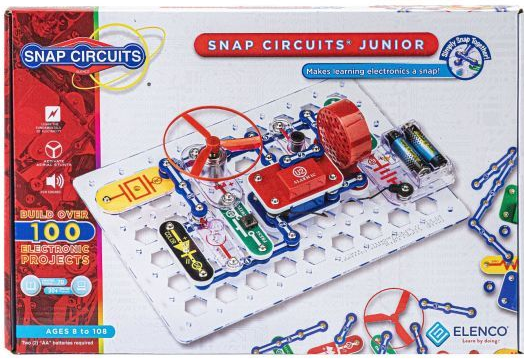
Snap Circuits Jr. offers a foundational introduction to electronics for young learners aged 8 and up. This kit includes over 30 color-coded, real circuit components that snap together to build over 100 exciting projects such as a flashing light, a siren with an adjustable volume, and much more. It’s an ideal starting point for students to explore the basics of circuitry and electronic projects without any tools required.
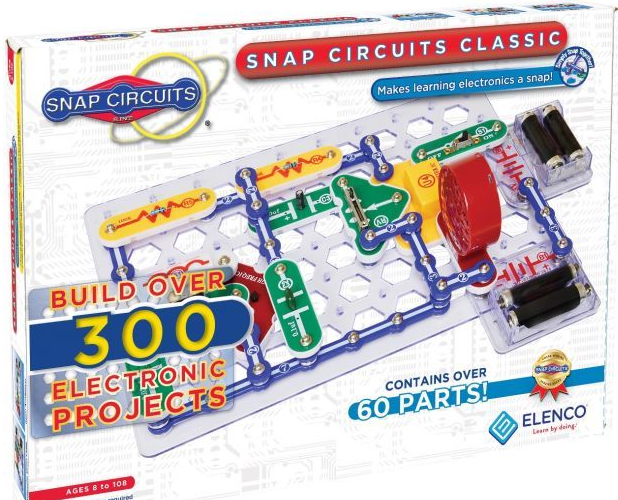
Snap Circuits Classic is designed to expand young engineers’ explorations with over 60 components for building more than 300 projects. This kit includes devices like microphones, capacitors, and motors, allowing students to create projects ranging from a simple light switch to a water detection alarm. Perfect for children aged 8 and above, it helps deepen their understanding of how various electronic components work together.
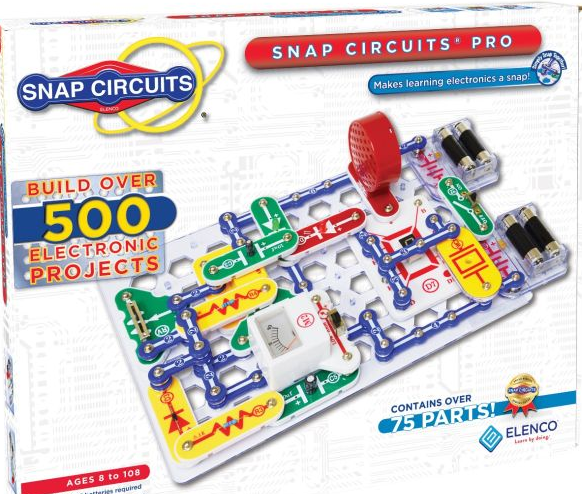
Snap Circuits Pro elevates learning with over 75 components to construct more than 500 experiments. With this advanced set, students can delve deeper into the world of electronics, building more complex circuits and projects including FM radios, digital voice recorders, and AC generators. It’s suitable for students who are looking to challenge themselves beyond the basics and explore intricate electronic systems.
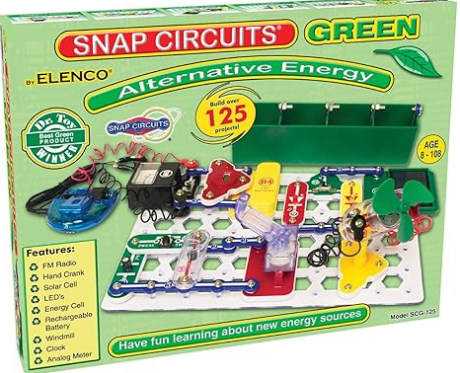
Snap Circuits Green focuses on renewable energy technologies, educating students about alternative energy principles through fun and engaging experiments. This kit includes over 40 parts for building over 125 projects involving solar cells, wind turbines, and hydroelectric power generation. It’s an excellent resource for teaching students aged 8 and up about sustainable energy solutions and the science behind them.
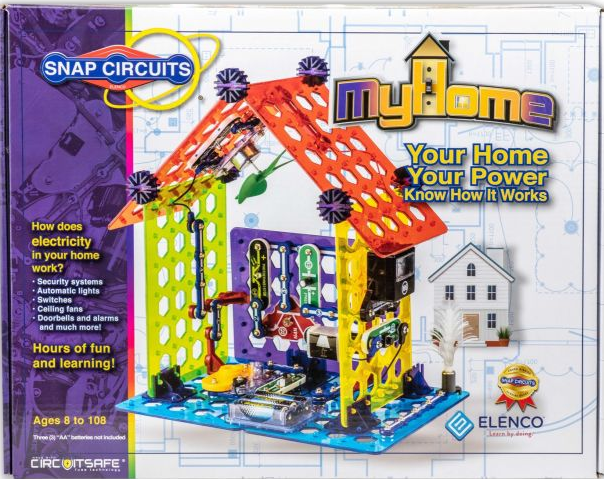
Snap Circuits My Home allows students to learn about electricity and how it powers homes by building models of various household electrical devices. With over 30 parts, this kit helps students discover how electricity travels through their home, how switches control power, and how to conserve energy. It includes projects that demonstrate real-world applications, such as alarms, doorbells, and much more, making it a practical and insightful educational tool.
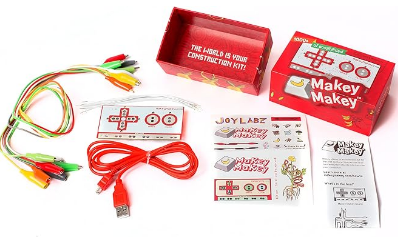
Makey Makey by JoyLabz: An Invention Kit for Everyone
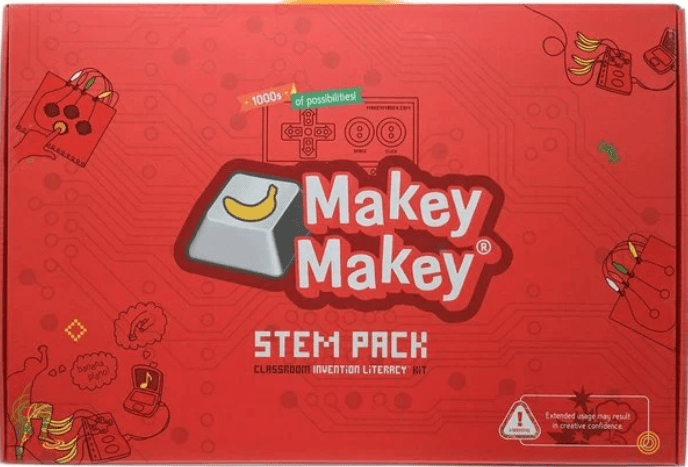
In my opinion, a must have in any STEM lab. Makey Makey is an inventive tool that transforms everyday objects into touchpads, opening a world of endless creative possibilities. This simple yet powerful kit can turn bananas into piano keys, sketchpads into game controllers, and much more, sparking imagination and innovation in learners of all ages. The Makey Makey website is a treasure trove of resources, offering extensive lesson plans and unit ideas that make integration into educational settings seamless. Additionally, Makey Makey can be combined with Scratch, enhancing its functionality by allowing users to create custom interactive projects. Whether for education or play, Makey Makey encourages exploration, learning, and creativity, making it an ideal tool for budding inventors and educators alike.
 The Mad STEM Lab